
Carbon Market Trends in 2026

Two years ago, I wrote about the carbon market trends shaping 2024 - new players entering the EU ETS, the first wave of carbon tariffs, and the early push for higher-integrity credits. A lot has changed since then. In 2026, carbon markets have moved from design to enforcement.
This year is less about announcements and more about money actually moving: border tariffs being collected at EU customs, Indian companies working under legally binding emission targets, and a global integrity benchmark deciding which credits buyers will touch. Here are the trends that matter in 2026.

CBAM Is Now Real Money
The EU's Carbon Border Adjustment Mechanism entered its definitive regime on 1 January 2026. Importers of carbon-intensive goods into the EU now need authorised CBAM declarants and face validation by customs before goods are released for free circulation, with the CBAM Registry connected in real time to national customs systems across all member states. A 50-tonne threshold keeps smaller importers, including most SMEs, out of scope under the Omnibus simplification package. For Indian exporters of steel, aluminium and other covered goods, carbon paperwork is now a shipment-level reality, not a future risk.
EU Carbon Prices - Slower Climb, Same Direction
The benchmark EU allowance is trading around 82 euros per ton. After the European Commission proposed an ETS overhaul on 17 July - letting industries emit for longer while offering more financial support for clean technology - analysts trimmed their forecasts to an average of about 80 euros per ton for 2026 and 89 euros for 2027. The direction is still up: the same Reuters survey puts prices near 95 euros in 2028 and above 100 euros by 2029. The Commission also plans to sell 400 million allowances to raise roughly 30 billion euros for an investment booster fund for industrial clean-tech. For anyone watching carbon as a cost line, the signal is a slower climb, not a reversal.
India's Carbon Market Goes Live
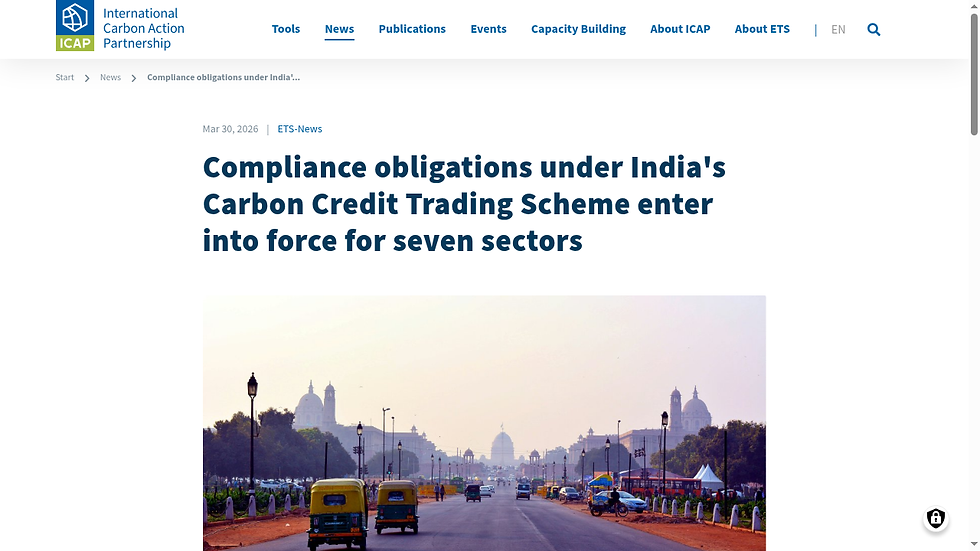
This is the trend closest to home, and the one I am asked about most. Compliance obligations under India's Carbon Credit Trading Scheme are now in force for around 490 entities across seven energy-intensive sectors - aluminium, cement, chlor-alkali, pulp and paper, petroleum refining, petrochemicals and textiles - with legally binding emission intensity targets for 2025-26 and 2026-27, and iron and steel and fertilizer still to come. Entities that beat their targets earn Carbon Credit Certificates, tradeable on India's power exchanges; those that fall short must buy and surrender them. The first compliance date was 31 July for the 2025-26 year, first CCC trading is expected around mid-2026, and the Indian Carbon Market Portal launched in March as the digital backbone of the whole system. India is no longer watching carbon markets from the sidelines.
Article 6 Moves From Paper to Practice
The UN carbon-crediting machinery under the Paris Agreement is quietly scaling. As of April 2026, 125 countries have designated national authorities for the Article 6.4 mechanism, over 1,140 prior-consideration notifications have been filed, and 85 voluntary-market projects have been authorised for international transfer. Countries like Vietnam are writing the rules for cross-border credit transfers into national law. Expect more government-to-government carbon deals, and more scrutiny on corresponding adjustments, through the rest of the year.
Integrity Becomes the Entry Ticket
The voluntary carbon market's reset continues. The ICVCM's Core Carbon Principles have become the reference point for what counts as a credible credit - governments are embedding them into national frameworks and developers are designing projects to meet CCP requirements from the start. Buyers in 2026 are asking one question before price: is this credit high-integrity? Projects that cannot answer that clearly are finding fewer takers, whatever their volume.

If 2024 was the year carbon markets expanded, 2026 is the year they started enforcing. For businesses, the practical step is to know your exposure - whether that is CBAM documentation for EU-bound shipments or a CCTS target for your facility. For professionals, it is the skills behind these systems - MRV, carbon accounting, market rules - that are turning into real career capital. That is exactly what we work on in our Carbon Market training at Sustainability 101:
I hope this helps you read the year ahead. We created a safe space for new enthusiasts who want to be part of the sustainability/ESG movement.
Pratiksha More, CEO and Director, Sustainability 101
Follow: Pratiksha on LinkedIn | Sustainability 101 on LinkedIn | Instagram | YouTube | Substack




Comments