
India and Japan Now Have a Carbon Credit Rulebook. Here Is What It Sets Up


India and Japan have finished writing the rulebook for creating carbon credits together. On 30 September 2026, the two governments launched the Operational Manual for the Joint Crediting Mechanism in New Delhi. Japan's Ambassador to India Keiichi Ono and the then Secretary at the environment ministry Tanmay Kumar launched it together.
This is the third step in building the mechanism. India and Japan signed the Memorandum of Cooperation on 7 August 2025. The Joint Committee adopted the Rules of Implementation on 8 June 2026. The manual completes the framework and lays out the full project cycle, from a Project Idea Note to the issuance and authorization of credits.

What the JCM is
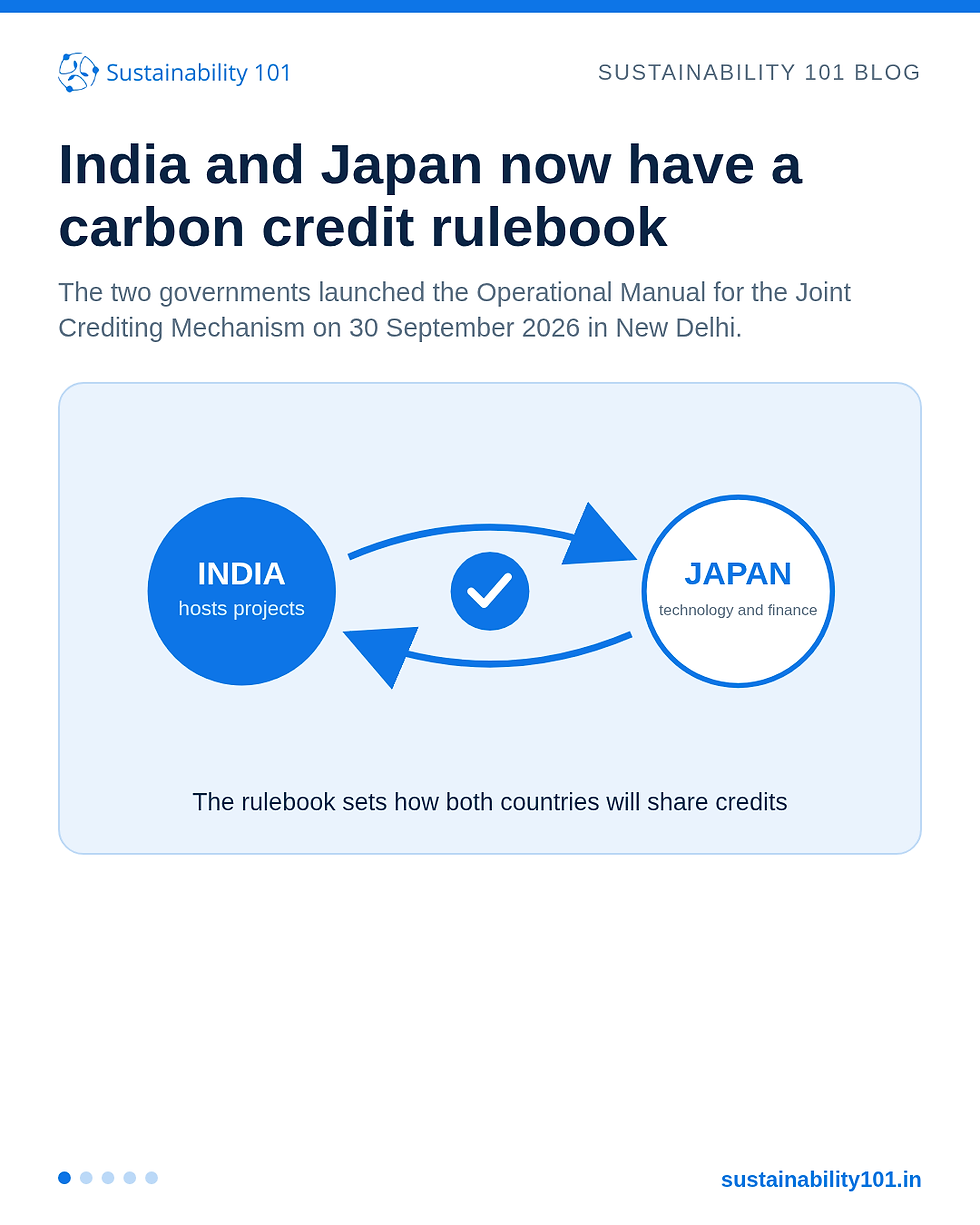
The Joint Crediting Mechanism is a bilateral system under Article 6.2 of the Paris Agreement. It is meant to promote the deployment of advanced low-carbon technologies in India, mobilize climate finance, and support high-integrity emission reductions and removals. Japan brings technology and finance. India hosts the projects. The mechanism contributes to the climate targets of both countries.
How the credits would be shared
Under the Memorandum of Cooperation, part of the credits from a project may count towards Japan's climate targets and the rest may count towards India's targets. Both governments apply corresponding adjustments, which are designed to prevent the same reduction from being counted twice. Credits issued in Japan's registry would be authorized as internationally transferred mitigation outcomes. Credits issued in India's registry would contribute to India's own targets. Each government can also authorize part of the credits for other international mitigation purposes.
A Joint Committee with representatives from both governments runs the mechanism. Both governments confirm each project's registration, the credit split, and every credit issuance before the committee decides.

Where things stand today
The framework is complete on paper. As of 13 October 2026, the official JCM website for India lists no approved methodologies, no designated third-party entities, and no registered projects. The Joint Committee's updates are the place to watch for the first approvals.

What to do now
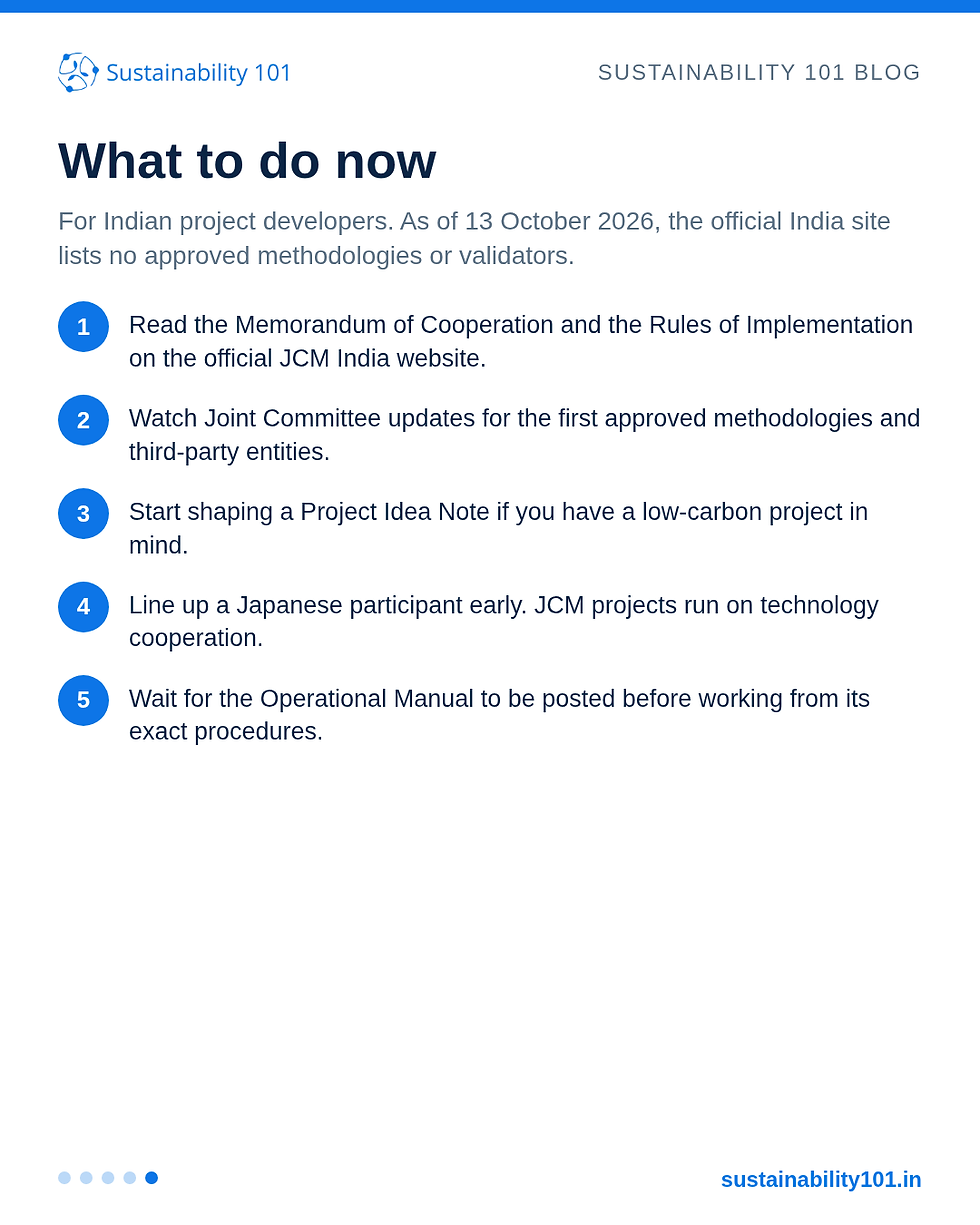
Read the Memorandum of Cooperation and the Rules of Implementation on the official JCM India website. Both are already posted.
Watch Joint Committee updates for the first approved methodologies and designated third-party entities.
If you are planning a low-carbon project in India, start shaping a Project Idea Note and line up a Japanese participant early. JCM projects run on technology cooperation between companies in the two countries.
Wait for the Operational Manual to be posted on the official website before working from its exact procedures.
Keep expectations realistic. The rulebook is ready, but projects can only register once methodologies and validators are in place.
The bigger picture
Article 6.2 lets countries trade emission reductions towards their climate targets. India and Japan have now built their plumbing. The next thing to watch is the first approved methodology on the official website.
Pratiksha More, CEO and Director, Sustainability 101


Comments